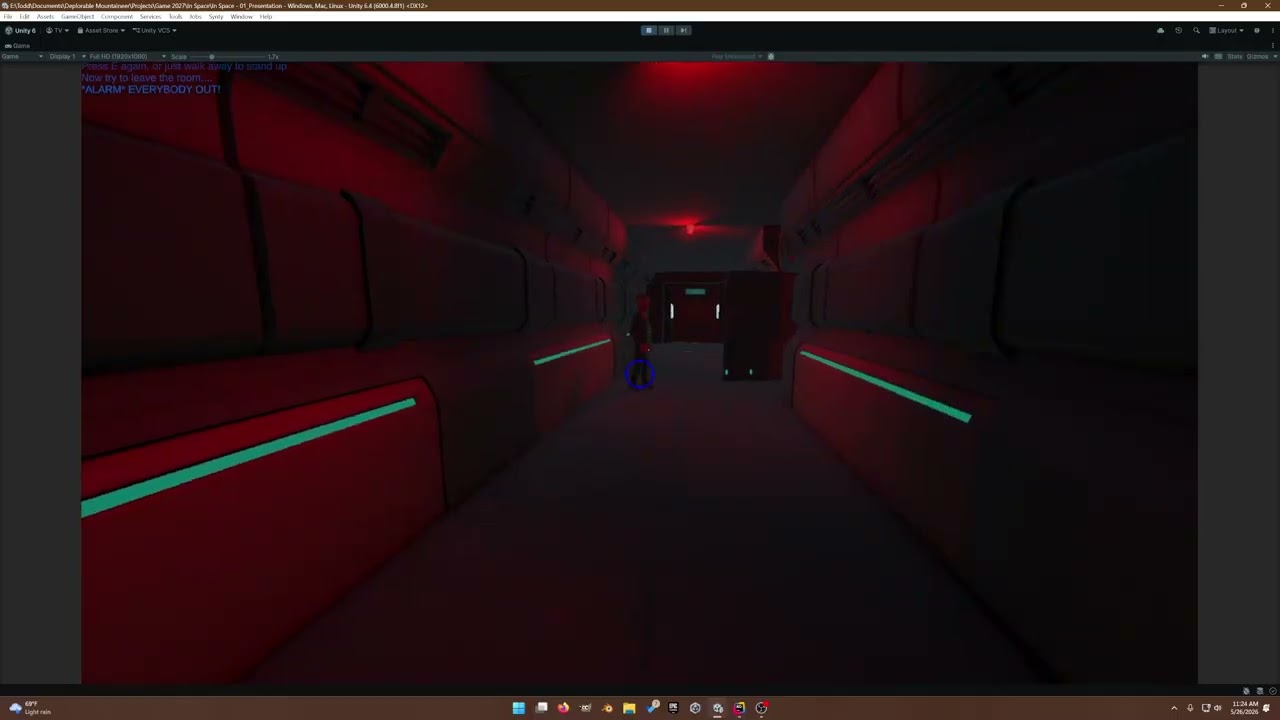
I just raced through the Level Design course, and did the final challenge (Set Dressing), a first moment of a first level of an FPS.
Our hero is stuck in a boring meeting. (Has that ever happened to you?) and then suddenly aliens started attacking the building. (Has that ever….ok, no, but I was once in a very interesting meeting interrupted by the Great Maryland/Virginia Earthquake of 2011).
So, I didn’t show everything. You don’t hear the whole “talk” because I followed the blue text instructions that triggered the alien attack before he got very far, but the guy is a nerd with a nasal voice (yeah, I talked through my nose into a mic) who talks slowly and repeats things a lot and keeps losing his place and starting over, obviously reading from a transcript. The room is full of interesting props, cellphone, tablet, and PDA (remember those?) on the table, a whoopi cushion hidden near one of the chairs, etc. Those meetings WERE boring!
And just for fun, here is the transcript I read from (inspired by a talk I actually sat through, walked out in the middle of a slide that was taking forever to go to the bathroom, came back and he was STILL on that slide….):
Ok, slide 37 took an hour, and now we are ready for slide…uh…38. Don’t worry, it will not take as long, certainly no more than 45 minutes. Now, as you can clearly see in this chart, the arrow is pointing to a specific transistor. Note how it connects to the other transistors close to it. This is a PNP transistor, which is sort of the opposite of an NPN transistor. A PNP transistor has a positively-doped silicon portion, followed by a negatively-doped silicon portion, followed by a positively-doped silicon portion. This is not like the NPN transistor, which has a negatively-doped silicon portion, followed by a positively-doped silicon portion, followed by a negatively-doped silicon portion. So, the PNP transistor has an emmiter, a base and a collector. The first positively-doped portion is the emitter. The second positively-doped portion is the collector, and the middle negatively-doped portion is the base. If there is a current flow between the emitter and the collector, then the base acts like a gate to regulate that flow. There is a graph of a transistor’s response curve, which will be on Slide 39 about forty minutes from now, that shows how the current permittivity changes according to the current applied to the base. This lets the transistor act like an analog switch. Of course, in digital circuits, the response curve is very sharp, almost, but not quite, a square wave. This means it is almost digital. Supporting circuit elements make it truly digital. With just two of these transistors, one can create a robust “Not” gate, as will be shown on Slide 40 which we should get to, perhaps before five-o’clock, but maybe not, but I am authorized to hold everybody here till we finish all 153 slides. Ok, so we can then take two not gates in sequence, and this makes a digital amplifier. With more transistors, we can create a Nand gate and a latch. Two latches wired together make a flip-flop, which is a robust one-bit memory unit. The whole circuit is mostly flipflops, Not gates, and Nand gates. In addition a clock circuit keeps it all in sync. Now stay awak for this, because now it gets really interesting. We are going to follow the path of a signal through all the transistors on this chart, so watch closely. The signal starts at a pin into the chip and goes through a very long circuit before it gets to its destination, and it does this faster than a single clock tick. If the chip is overclocked and it ticks too fast, the path will not be completed and bit errors will start building up. Then there is the problem with heat: you cannot move bits without generating heat. The more bits you move, the more heat. That is why we use air, water, and fluorinert cooling systems, as well as heat sinks and other cooling systems to cool the system. If not for that, the chip will be permanently damaged from the excessive heat. As they say, when the magic smoke leaves the chip, the magic is gone. Oh I lost my place. I guess that means I have to start over. Well, here goes.
REPEAT (stumble in second sentence, repeat again all the way through, then, the audio just loops for as long as the player is willing to let it run).