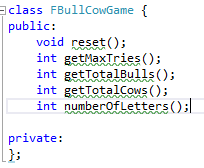
I decided I wanted to just have the model around the game rules and not move operations such as input-output, user interaction, etc., in the same file. I suppose I should do this in a branch if I want to see how this separation of abstractions can work as we go beyond this challenge point.
PS: I used *.hpp instead of *.h because this file requires C++ and won’t work in in a C program. Visual Studio doesn’t mind.
#pragma once
/* BlueCowGame.hpp 0.0.1             UTF-8                        2016-12-22 */
/* ------1---------2---------3---------4---------5---------6---------7------ */

#include <string>

class FBullCowGame
{  /* A model for the Bulls and Cows Game.
      This model has no side-effects beyond its encapsulated state,
      so there is no input-output here. */

public:
    FBullCowGame(std::string SecretWord);
        /* Each instance has its own alpha isogram, with the word
           size determined automatically.
           */

    unsigned int WordSize();
        /* The size of the SecretWord.  0 if SecretWord was improper. */

    void CheckGuess(std::string Guess);
         /* TODO: Return an integer or enum value about the Guess? */

    bool IsOnlyLetters();
         /* When there are only alpha characters in the current guess*/

    bool IsCorrectLength();
         /* When the alpha string is of the correct length */

    bool IsIsogram();
         /* When the guess is a well-formed isogram of correct length */

    bool IsSecretGuessed();
         /* The guess is correct (WordSize of Bulls) */

    unsigned int Bulls();
        /* the number of Bulls in the current Guess, or 0 */

    unsigned int Cows();
        /* the number of Cows in the current Guess, or 0 */

    unsigned int WellFormedTries();
        /* the number of guesses for which IsIsogram was true */

    unsigned int SuggestedMaxTries();
        /* the number of tries suggested as a limit for the
           current SecretWord */
        // TODO: Over-ride with a constructor parameter?

private:
    std::string MySecret;
    int MyWordSize;
    std::string MyCurrentGuess;
    int MyMaxSuggestion;
        // TODO: Completely hide the implementation?

};